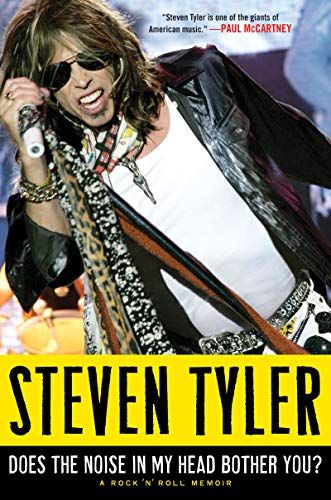
Title: Does the Noise in My Head Bother You?: A Rock ‘n’ Roll Memoir
Authors: Steven Tyler
Published: 2012
Version reviewed: Audiobook
In 1986 – at 12 years old – I first saw and heard Steven Tyler as he screeched his way through a song called “Walk This Way”, seemingly as a side-act to three sneaker-wearing rappers. My years were few but I’d never seen anything like this. He danced, he screamed, scarves flew – and he looked a bit like a lady…
Over the next couple of years, Aerosmith went on to become my favourite band, And I wasn’t just crazy about their modern hits, but also their 70s classics that I eventually caught up on in the early 90s. Juvenile as it seems now that I’m almost 50, Tyler was my “idol”. I hung on his every word through his interviews and his songs. I grew an affinity with the rest of the band members too as they often featured prominently in the videos despite the Joe Perry/Tyler combo being the epicenter of the group.
I tell you all this because I wasn’t far in to this book when I became a little put off by Steven Tyler’s personality. I don’t consider myself a prude but the relentless stream of self-aggrandizing stories about his sexual appetite was a bit eyerolling. Even when starting out in the band Chain Reaction in the mid 60s, he used to tell his mother that they would need bars on the windows to keep the girls out (he was right). Part of me thought, “it’s his book and this is the story he wants to tell.” The other part of me thought, “do I really need to know all this?” Clearly other people didn’t need to hear it as the intimate recounting of his sexual relationship with a 16 year old girl who was 9 years his junior, led to a lawsuit, and was the catalyst for me picking up this book over a decade after it came out.
He also discusses drugs in no uncertain terms. Oh, the drugs. In the early 90s one of the big topics in interviews was recounting the drug use and the band’s subsequent sobriety. I guess I heard it so often that it started to sound like the story had become a parody of what it must have really been like. But if Tyler’s re-telling is remotely accurate, there was a lot of drugs. Might sound like a promotional tagline, but he is probably lucky to be alive. The comprehensive history of his compulsive drug use means that there’s not many chapters without mention of blow or heroin. It’s no secret that there have been relapses in the last few decades and he revisits them with, one would assume, a relative level of openness.
Who does Steven Tyler like? Not a lot of people. He has little positive to say about anyone outside of his parents, his children, and maybe Richie Supa. While he at no point denigrates the talent of his bandmates, many chapters are replete with not-so-subtle jabs at them. “Those fuckers” is a common refrain as he reflects on the time they all stopped talking to him or they tried to replace him as lead singer or they didn’t like his lyrics. He tells one anecodate about how he brought a lyric he’d just written for the song “Fever” to the band, and instead of an ovation, Tom Hamilton said “you’re not singing that lyric on my album”. It didn’t go down well.
He also doesn’t miss the opportunity, on multiple occasions, to talk about the band members who he says were/are still “using”. They might talk about how they are “brothers” and so on, but, unelss these guys function a lot differently to regular folks, there has to be a ton of resentment in the band. Personally I’d tend to side with the other four guys as the common antagonist through it all is Tyler.
But why do they stick with it? Probably because we have four musicians who would be playing to a tenth of the audience if it wasn’t for the lead singer. But, also, we have a lead singer who, without this rock juggernaut he built with them, would be a supergroup singer-for-hire or performing country rock that no one cares about.
However, just because I don’t like his reality, doesn’t mean it’s not a fascinating and well written book. It’s not just a tirade of complaints towards Joe Perry (and both his wives), John Kalodner, Tim Collins, concert promoters, and the media – there’s significant focus on the tours and the music. It’s clear which songs Tyler is most proud of (“Dream On”, ‘Seasons of Wither”), or songs that mean a lot to him such as the first song he wrote with Joe Perry (“Movin’ Out”). Then there’s the declaration that the troubled 1997 album “Nine Lives” is “fucking great” (and I agree with him) and it’s clear how much he reveres Aerosmith’s only number 1, “I Don’t Want to Miss a Thing” (I don’t agree with him). I’d like to have heard more about the recording of “Rock in a Hard Place”, a very underrated record that is notable for the temporary absence of both Aerosmith’s guitarists. There is some talk about how cool Joe’s replacement Jimmy Crespo was and how crazy Rick Dufay (Brad Whitford’s stand-in) was, but I’d have liked a bit more. Maybe he just couldn’t remember.
At the end of the audiobook (which is very well narrated by Jeremy Davidson), Tyler does a short piece about writing the book, talking about how cathartic it was. As I listened to him, I felt like I was under his spell again. He’s emotionally intelligent, infinitely interesting, and (at one time anyway) a creative powerhouse. Maybe a little sleaze, complexity, egotisim and bullying is a small price to pay for all that.
 nearvana